
Recycled EPS Black Pellets from Japan
Shipped from Kanto Region via Tokyo Port or Yokohama Port to Taiwan, ASEAN, Vietnam
Plastic Pallet Co., Ltd. (Chiba Prefecture) supplies recycled EPS black pellets with full physical properties verified. MFR 20.934 g/10min, flexural modulus 2,748 MPa — 44% higher than typical HIPS. Strand-cut process, no surface contamination, glossy uniform cylindrical pellets. Japanese manufacturing quality. Shipped from the Kanto region via Tokyo Port or Yokohama Port — direct export across Asia.
1. Product Overview — Japanese Properties Verified Recycled EPS Black Pellets for Injection Molding
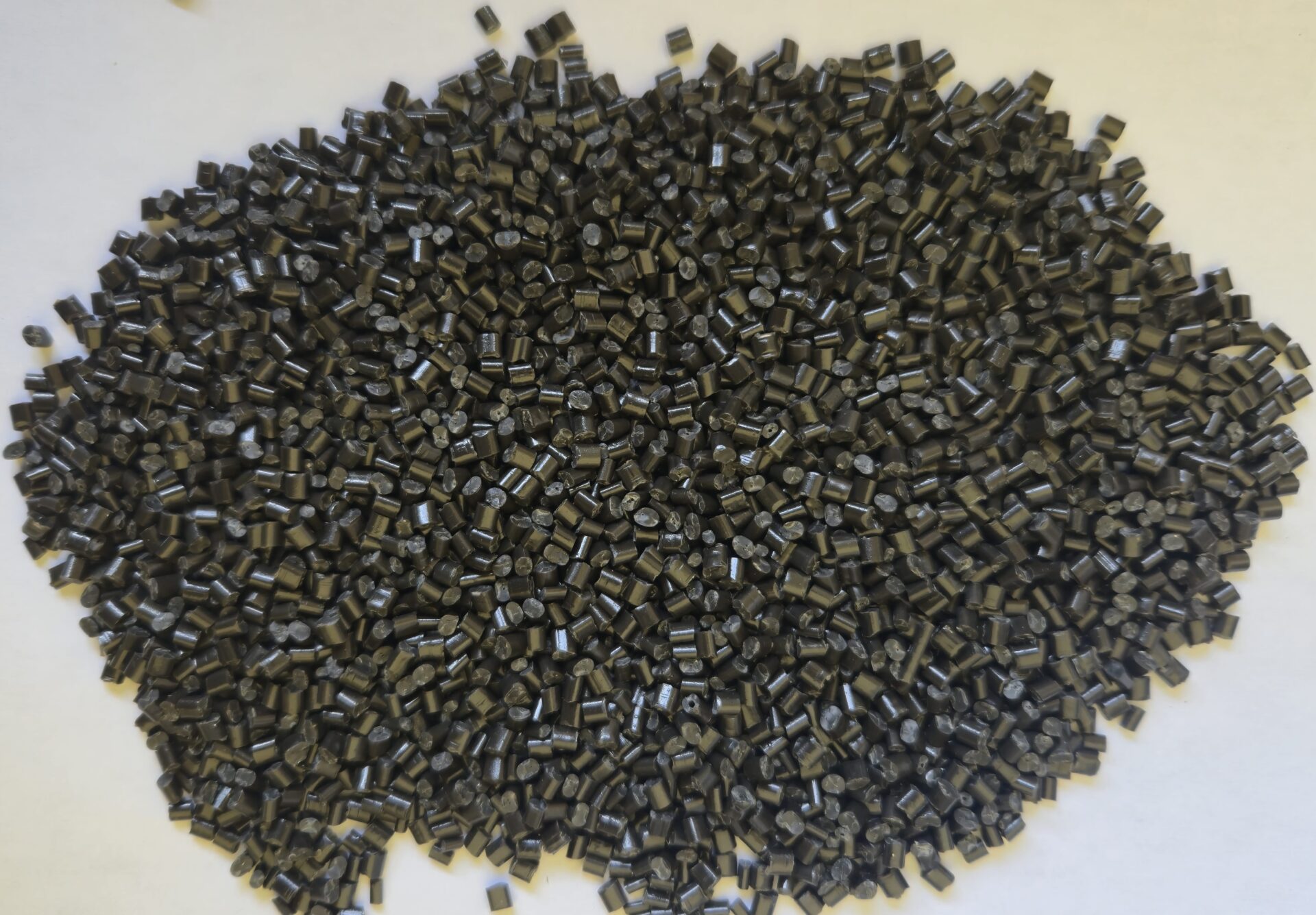
The recycled EPS black pellets featured here are produced from polystyrene (PS / EPS) waste collected through Japan's domestic recycling network. The waste is shredded, washed, melt-extruded, and pelletized via strand-cut process into uniform cylindrical pellets. The finished pellets display a consistent dark charcoal-black color, suitable for injection molding and extrusion applications.
✓ Four Visual Quality Markers
- Strand-cut pelletizing process — Uniform pellet shape, stable particle size, high dosing precision
- No surface contamination, no black spots, no foreign matter — Low molding defect rate, clean finished surface
- Uniform glossy surface — Minimal thermal degradation of resin, stable melt flow
- Clean cylindrical separation — Smooth auto-feeding, no bridging in injection molder hopper
(Melt Mass Flow Rate)
(+44% vs HIPS)
(Flexural Test)
(Standard PS range)
2. Full Test Report — Physical Properties Verified
This lot of recycled EPS pellets was tested at an accredited Japanese testing facility. Test specimens were prepared using a J80 ADS injection molding machine, in two specifications: rectangular bar type (width 10.022 / thickness 3.911 mm) and dumbbell type (width 10.004 / thickness 3.917 mm). Measurements were conducted in accordance with standard plastic testing methods.
| Test Item | Value | Unit | Method |
|---|---|---|---|
| Melt Mass Flow Rate (MFR) | 20.934 | g/10min | MFR Test |
| Charpy Impact Strength (notched) | 0.593 | kJ/m² | Charpy Impact Test |
| Tensile Yield Stress | 33.47 | MPa | Tensile Test |
| Tensile Stress at Break | 33.19 | MPa | Tensile Test |
| Tensile Strain at Break | 2.37 | % | Tensile Test |
| Flexural Strength | 51.756 | MPa | Flexural Test |
| Flexural Modulus | 2,748.474 | MPa | Flexural Test |
| Specific Gravity | 1.0306 | - | Density Test |
| Moisture Content | 1,537.76 | ppm | — |
* Values shown are measured results, not guaranteed specifications. Test specimens prepared using J80 ADS injection molding machine.
3. Comparison vs. Typical HIPS — 44% Higher Flexural Modulus
Against the market-standard HIPS 6045 (typical high-impact polystyrene grade), this recycled EPS pellet shows clear stiffness advantages. In particular, flexural modulus and flexural strength reach levels comparable to engineering-grade GPPS, making this product well suited for injection molding applications that demand high stiffness and dimensional stability.
| Property | This Recycled EPS | HIPS 6045 (typical) | Difference |
|---|---|---|---|
| MFR (g/10min) | 20.934 | 4 (200°C / 5kg) | 5x higher flow |
| Flexural Modulus (MPa) | 2,748 | 1,900 | +44.7% |
| Flexural Strength (MPa) | 51.76 | 24–93 range mid | Upper-mid range |
| Tensile Stress at Break (MPa) | 33.19 | 25 (typical) | +32.8% |
| Specific Gravity | 1.0306 | 1.03 | ±0.001 (high purity) |
This recycled EPS outperforms typical HIPS across three critical metrics: MFR (injection flowability), flexural modulus (stiffness), and tensile stress at break (strength). The specific gravity of 1.0306 is virtually identical to pure polystyrene standard (1.03), indicating extremely low contamination and high purity — visually confirmed by the absence of foreign matter on pellet surfaces. The notched Charpy impact strength of 0.593 kJ/m² falls within the GPPS range — this is a high-stiffness, low-impact-absorption recycled PS, ideally suited for rigid injection-molded products: appliance housings, small components, office supplies, storage containers, industrial fittings, and similar applications where toughness is not the primary requirement.
4. Asia Recycled PS Market — Multi-Billion Dollar Scale, 33% YoY Growth, Taiwan's #2 Global Recycling Rate
Asia Recycled PS Pellet Market 2026 — Key Figures
- Global Polystyrene (PS) Market: USD 4,447.99 million in 2026, projected to reach USD 5,512.68 million by 2035 (CAGR 2.41%)
- Asia-Pacific Share: Asia-Pacific leads the market with 52% global share in PS production and consumption
- Recycled PS Usage Growth: Recycled polystyrene usage increased by 33%, especially in food and electronics packaging
- EPS Recycling Rates by Country: 46% in China, 68% in Japan, 88% in Korea, 83% in Taiwan
- Asia-Pacific Recycled Plastic Granules: A projected 45.8% of the market share in 2026
- HIPS Market CAGR: Expected to expand at a CAGR of 12.4% from 2026 to 2030, reaching approximately USD 78.5 billion by 2030
- PS Recycling Efficiency Gain: Mechanical recycling enhancements boosted PS recycling efficiency by 21% in 2024–2025
- Vietnam Recycled Plastics: Around 280,952.75 tons in 2025, growing at CAGR 9.00% to 665,117.31 tons by 2035
Asia's recycled PS market is at a critical inflection point — "rapidly expanding demand alongside inconsistent supply quality." Multiple industry sources highlight that Asian imports are being affected by contamination issues, with one of the largest automotive parts manufacturers forced to scrap a complete production run because of inconsistent melt flow rates. Against this backdrop, "Japanese recycled raw materials with verified properties and transparent test data" have become the precise supply source that Asian buyers urgently seek.
Taiwan Market: High Recycling Rate + Electronics Manufacturing Cluster
Taiwan's EPS recycling rate reaches 83%, second only to South Korea (88%) in Asia. Yet domestic Taiwanese supply of recycled PS pellets is dominated by EPS foam grind, with limited availability of uniform pellets suitable for injection molding. Taiwan's electronics and home appliance assembly industries are dense, demanding dimensionally stable, purity-verified recycled PS. This product's verified property data and 2,748 MPa flexural modulus fill that exact gap.
ASEAN Market: HIPS Demand at 12.4% CAGR · Automotive Interiors · Appliances
HIPS demand across Vietnam, Indonesia, Thailand, and Malaysia is expanding at a 12.4% annual rate, driven by EV production (14 million units globally projected in 2026), home appliances, and consumer electronics manufacturing concentrated in Southeast Asia. Vietnam imported more than 5.5 million tons of plastic feedstock in the first 7 months of 2025, with domestic supply meeting only 15–35% of demand — creating extremely high dependence on imported recycled materials.
Pan-Asian Demand Outlook · Cross-Border Trade Flow · 2026 Pivotal Year
2026 marks a pivotal benchmark year for Asian polystyrene markets, with the transition from post-pandemic volatility to strategic adaptation. Production and consumption remain heavily concentrated in Asia, with China commanding the largest share of both supply and demand, but competitive dynamics are evolving rapidly. Taiwan led global PS exports in 2024 at USD 922 million in value, followed by Belgium (USD 800 million) and China (USD 763 million) — making Taiwan the world's #1 PS export hub.
The Asia-Pacific polystyrene market is projected to grow at approximately 5% annually, holding around 15% of global PS market share by 2026. Key demand drivers include:
Pan-Asian Demand Drivers — 2026
- Electronics & Appliances: HIPS demand in electronics grew 17% in 2024–2025, driven by consumer electronics expansion across China, Korea, Taiwan, and ASEAN
- EV-Related Components: HIPS adoption in EV interiors and components is the leading growth segment, with manufacturers integrating up to 22–40% recycled content in new PS compounds
- Insulation & Construction: EPS insulation usage increased 29% under new thermal efficiency regulations requiring R-15+ ratings in many regions
- Recycled Content Mandates: Vietnam targets 25% recycled content in plastic packaging by 2030; ASEAN regulations are tightening across packaging, automotive, and consumer goods sectors
- Quality Premium: Mechanical recycling efficiency improvements (+21% in 2024–2025) are still concentrated in Japan, Korea, and Taiwan — Southeast Asia imports remain quality-variable, creating premium positioning for verified Japanese material
For injection-molding buyers operating across multiple Asian countries, consolidating procurement around verified Japanese material reduces qualification overhead: a single material specification can be approved once and rolled out across factories in Taiwan, Vietnam, Thailand, Indonesia, and beyond. This contrasts with sourcing from multiple regional suppliers, each requiring separate quality verification cycles.
5. Export Terms — Tokyo Port / Yokohama Port FOB · FLECON BAG · 40ft Container Standard
This product ships from Tokyo Port or Yokohama Port, Japan, reaching major Asian ports — Keelung, Kaohsiung, Ho Chi Minh, Hai Phong, Singapore — in 5–10 days. Standard shipping units are FLECON BAG (ton bag) packaging in 40-foot dry containers (approx. 24 tons).
| Item | Specification |
|---|---|
| Origin | Kanto region, Japan (Tokyo Port or Yokohama Port FOB) |
| Packaging | FLECON BAG (ton bag) / approx. 500–1,000 kg per bag |
| Standard Container | 40-foot dry container / approx. 24 tons |
| Minimum Order | 40ft container unit (approx. 24 tons) |
| Destination Ports | Keelung, Kaohsiung, Ho Chi Minh, Hai Phong, Singapore, Manila, etc. |
| Transit Time | 5–10 days (from Tokyo Port / Yokohama Port) |
| Payment Terms | T/T or L/C (negotiable) |
| Samples | Available upon request (terms to be discussed) |
📩 Quote Request · Sample Request · Direct Contact
Tell us your required quantity and destination port — we'll provide a quote in the shortest possible time.
properties verified. Direct shipment from Japan via Tokyo Port or Yokohama Port FOB.
6. FAQ — Common Questions
Q1. What molding applications is this recycled EPS pellet suited for?
With its high flow rate (MFR 20.934 g/10min) and high stiffness (flexural modulus 2,748 MPa), the product is best suited for injection molding and extrusion. Specific applications include: appliance housings, office supplies, storage containers, industrial fittings, automotive interior rigid parts, garden containers, stationery, and rigid toy components. Charpy impact strength of 0.593 kJ/m² (notched) falls within the GPPS range, so this product is not recommended for applications requiring high impact absorption (e.g., protective packaging or cushioning materials).
Q2. Why is Japanese recycled feedstock quality reliable?
Since the 1995 Container Recycling Act and the 2022 Plastic Resource Circulation Act, Japan has built one of the world's most rigorous collection and sorting systems. Japan's EPS recycling rate stands at 68% (third globally), and recycled PS pellet properties are tested using standard plastic testing methods. This product has nine physical property indicators verified — providing an objective foundation for your procurement decisions.
Q3. Are samples available?
Samples are available upon consultation. Sample size, lead time, and shipping arrangements will be discussed based on your specific evaluation requirements. If you have additional test requirements (e.g., MFR at custom temperatures, flash point, post-molding properties), additional testing can also be arranged.
Q4. What is the minimum order quantity?
The minimum order is one 40-foot container (approx. 24 tons). This is the standard shipping unit for FOB export from Tokyo Port or Yokohama Port. For lot size, frequency, and destination, please contact us for tailored arrangements.
Q5. What is the origin and traceability of this product?
This lot is a Japan-domestic collection · Japan-domestic recycling product, manufactured at a Japanese facility using the strand-cut process, with full physical properties verified. Plastic Pallet Co., Ltd. (Chiba, Japan) ships from its Kanto-region warehouse via Tokyo Port or Yokohama Port to Taiwan, ASEAN, and Vietnam.
Q6. Does this pellet comply with RoHS, REACH, food contact regulations?
This is a mechanically recycled PS pellet. RoHS (Restriction of Hazardous Substances) and REACH (Substances of Very High Concern) compliance must be evaluated case-by-case depending on application and customer requirements. Direct food contact, medical applications, infant products, and cosmetic containers are not recommended for mechanically recycled PS — for these regulated applications, please use virgin PS or chemically recycled PS instead.
Q7. How is pricing determined?
Pricing is determined based on (1) raw material market conditions, (2) order quantity, (3) shipping terms (FOB Tokyo Port / Yokohama Port), (4) exchange rate, and (5) logistics costs. Pricing structures differ between continuous-contract and spot orders, so please share your expected monthly volume, delivery frequency, and destination port. Recycled material generally offers cost advantages over virgin resin, with larger volumes commanding more competitive pricing.
Q8. What are typical lead times?
Lead time depends on inventory status, order volume, and destination. When stock is available, orders proceed to shipment preparation upon confirmation. FOB shipments are handled at Tokyo Port or Yokohama Port, with 40-foot containers (approx. 24 tons) as the standard unit. Vessel scheduling varies by destination and container availability; confirmed delivery dates will be provided after order confirmation. If stock is depleted, additional lead time for new lot production may be required.
Q9. Is continuous supply available? What is the monthly stable volume?
Continuous supply arrangements are welcome. Due to the nature of recycled raw materials, monthly volume may fluctuate based on collection yield and market conditions. We recommend sharing your annual usage, monthly required volume, and acceptable lot-to-lot variation in advance, after which we can propose annual or semi-annual supply contracts. For continuous accounts, lot-change advance notification and updated property data can be provided as part of the quality management process.
7. Why Source from Japan — Plastic Pallet Co., Ltd. (Chiba)
Plastic Pallet Co., Ltd. is headquartered in Chiba Prefecture, Japan. Plastic pallets (including recycled-content pallets) are our core business, and we also supply cost-competitive, high-quality Japanese recycled plastic raw materials to overseas molding manufacturers for their downstream products.
Our advantages include:
- Full traceability of Japan-domestic collection — the entire supply chain (collection sources, shredding contractors, recycling facilities) is composed of Japanese domestic enterprises
- physical properties verified — verified property data for each product offering
- Tokyo Port / Yokohama Port access — Kanto-region logistics with direct access to two major export ports, well-positioned for Asian export routes
- Multilingual support — quote, customs documentation, and delivery support in Japanese, English, Traditional Chinese, and Vietnamese
- 40ft container shipments — full-container loads (approx. 24 tons) per shipment
📚 Sources & Evidence
- Accredited Japanese testing facility "Test Report · EPS Pellet" — Primary data for the 9 physical property values (MFR, Charpy, tensile, flexural, specific gravity, moisture).
- Fortune Business Insights "Polystyrene Market Size, Share & Growth | Global Report 2034" — 2026 Asia-Pacific 49% share, GPPS/HIPS segment split, market scale.
- Industry Research "Expanded Polystyrene (EPS) Recycling Market Share & Trends 2035" (April 2026) — EPS recycling rates by country (Korea 88%, Taiwan 83%, Japan 68%, China 46%), market segmentation.
- 360 Research Reports "Polystyrene (PS) Market Size, Share, Trend" (January 2026) — Global PS market USD 4.45B (2026) → USD 5.51B (2035), Asia-Pacific 52% share, recycled PS usage +33%.
- Coherent Market Insights "Recycled Plastic Granules Market Size & Forecast 2026-2033" — Asia-Pacific 45.8% market share, Japan policy summary.
- Bright Rubber Plastic "High-Impact Polystyrene (HIPS) Market Report 2026" — HIPS market CAGR 12.4%, USD 78.5B by 2030, EV manufacturing demand driver.
- Earth911 "The State of Polystyrene Recycling In 2026" (March 2026) — Country-by-country EPS/HIPS recycling realities, US/Canada 45-company / 50-facility landscape.
- Petrobon Trading "HIPS 6045 Technical Data Sheet" — HIPS 6045 typical grade reference (flexural modulus 1,900 MPa, MFI 4).
- UL Prospector "Polystyrene (PS) - Properties, Processing" — GPPS/HIPS property ranges and molding application notes.
- Expert Market Research "Vietnam Recycled Plastics Market Size, Analysis 2026-2035" — Vietnam recycled plastics 280,952 tons (2025) → 665,117 tons (2035) at CAGR 9.0%.
- S&P Global Commodity Insights "High cost of recycled plastic pellets in Asia, US" (July 2025) — Asian recycled pellet pricing, quality issues, supply-chain bottlenecks.
- IndexBox "Asia-Pacific Recycled ABS/PS (PCR) Market" (February 2026) — Asia-Pacific recycled PS market structure, Japan-to-manufacturing-hub cross-border trade dynamics.
- Mordor Intelligence "Vietnam Plastics Industry Analysis | Market Report" (January 2026) — Vietnam 5.5M tons feedstock import in 7 months of 2025, 15-35% domestic supply.
- ClimateSort "Recycled Plastic Pellets Guide 2026" (December 2025) — Asian contamination issues, automotive-grade MFR consistency problems.
8. Related Articles — Japanese Recycled Plastics · Asia Export · Plastic Logistics
English-language archive on Japanese plastic logistics containers, recycled materials, and pallet products. All articles targeted at ASEAN and global English-speaking markets.
Recycled PlasticsFull circular economy report on Japanese domestic plastic logistics containers and recycled raw materials — from collection, shredding, pelletizing, to re-molding.
Vietnam MarketVietnam recycled plastic import market structure, EPR regime, key buyers, and Japanese business entry opportunities. Vietnamese-language version also available.
Feedstock MarketsMiddle East situation, naphtha, ethylene series, and Japanese plastic raw material procurement — the integrated background to recycled raw material supply-demand logic.