
Japanese Recycled PP & PP/PE Pellets
for Asian Plastic Pallet Manufacturers
Premium Japan-origin recycled polypropylene and PP/PE blend pellets, supplied directly to plastic pallet manufacturers, injection molders, and logistics-product makers across Taiwan, South Korea, Vietnam, Thailand, Indonesia, and other Asian markets. Test data sheets, FIBC packaging, and FCL container shipping included as standard.
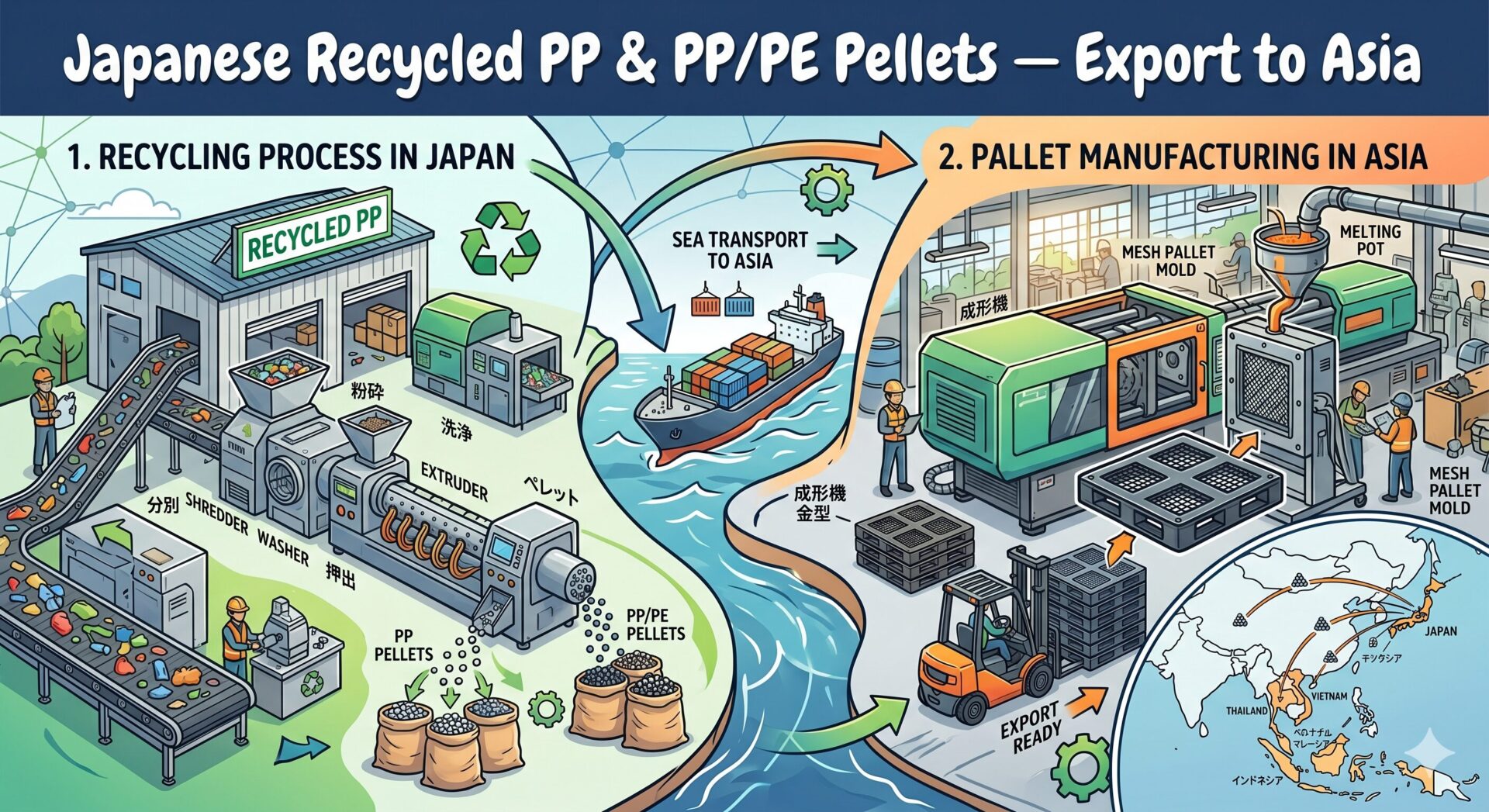
Plastic Pallet Co., Ltd. exports four grades of Japanese-origin recycled PP and PP/PE pellets to Asian plastic pallet manufacturers and injection molders. Grades #1, #2, and #4 are PCR (Post-Consumer Recycled), and Grade #3 is ASR-origin (automotive shredder residue). Three of the four grades have proven track record in one-way pallet molding inside Japan. Standard supply is FIBC packaging, 40-foot FCL container shipment of approximately 24 tons per grade, with monthly availability of 1–3 containers per grade. The recommended approach for stable, scalable supply is to use Grade #3 as the base resin and blend Grade #1, #2, or #4 into it as a property modifier.
Supply at a Glance
Who This Is For
This product range is built for buyers who need consistent, traceable, Japan-origin recycled polyolefin rather than commodity-grade mixed scrap. We focus on three buyer categories across Asia:
- Plastic pallet manufacturers in Taiwan, South Korea, Vietnam, Thailand, Indonesia, Malaysia, and the Philippines producing one-way (export) pallets, returnable pallets, and heavy-duty industrial pallets.
- Injection molders producing logistics products such as containers, crates, returnable boxes, dunnage, and industrial parts where cost-effective recycled resin is preferred over virgin PP.
- Compounders and trading houses looking for stable Japanese feedstock to blend with virgin or other recycled streams for property tuning and cost optimization.
Product Lineup Overview
| Grade | Origin | Color | Pellet Shape | Track Record | Best For | Monthly Supply |
|---|---|---|---|---|---|---|
| #1 Recycled PP/PE | PCR | Gray | Hot-Cut | One-way pallet molding (proven) | Balanced general-purpose grade | 1–2 containers |
| #2 Recycled PP/PE | PCR | Brown | Hot-Cut | One-way pallet molding in Japan | Stiffness-oriented thick-wall parts | 2–3 containers |
| #3 Recycled PP (ASR) | ASR | Black | Strand-Cut | One-way pallet molding (proven) | High-impact / heavy-duty applications | 2–3 containers |
| #4 Recycled PP/PE | PCR | Olive-Gray | Strand-Cut | Bulking compound for pallets & molded parts in Japan | Bulking / blending / cost reduction | 2–3 containers |
Grade #1 · Recycled PP/PE — Gray, Hot-Cut
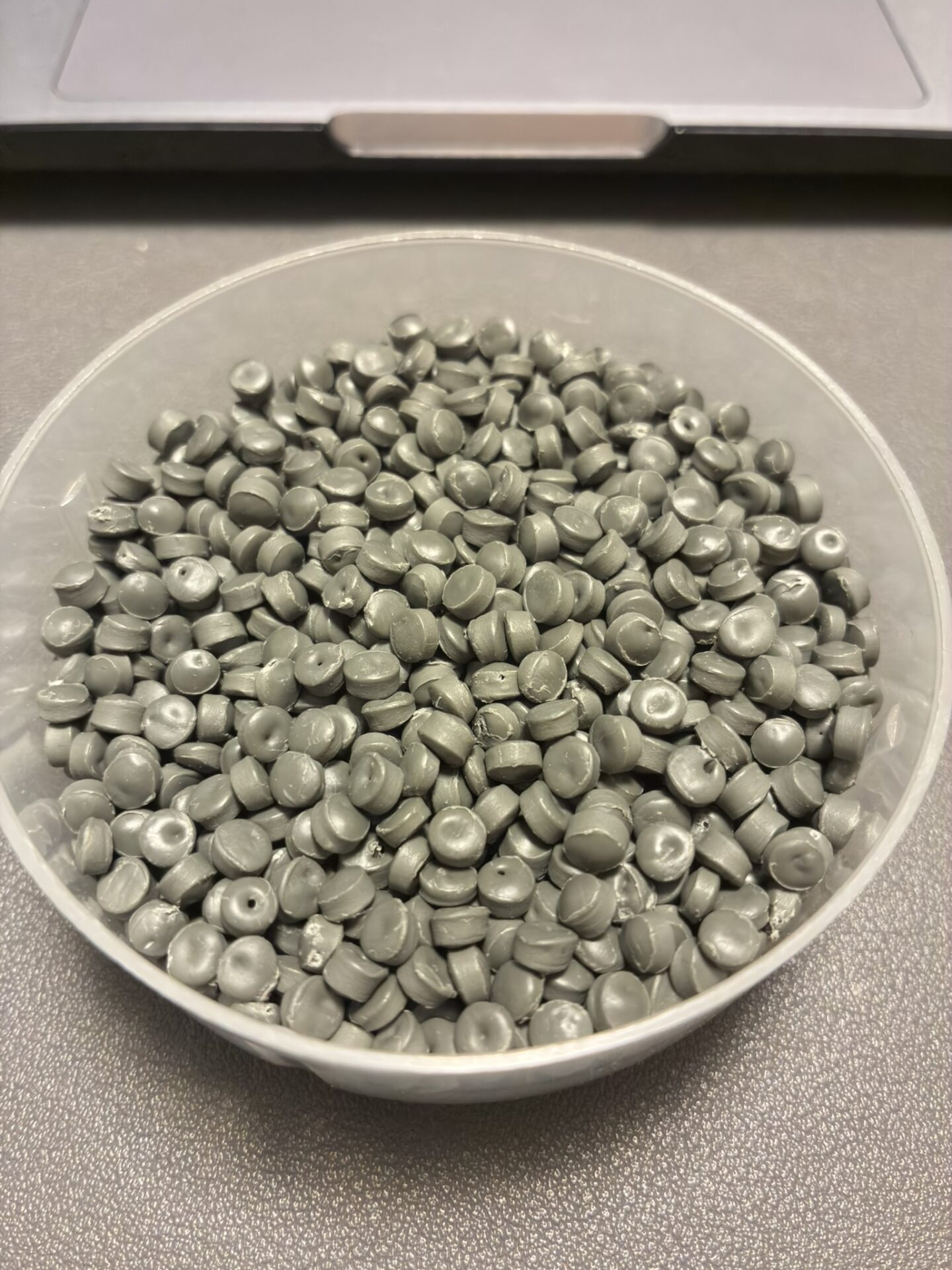
Recycled PP/PE Pellet — Gray, Hot-Cut
Balanced general-purpose grade · proven in one-way pallet molding
Grade #1 is a gray-colored hot-cut PCR (Post-Consumer Recycled) PP/PE pellet with a proven track record in one-way pallet molding. It is one of the easiest grades to propose to overseas pallet makers and logistics-product manufacturers because Japanese converters have already validated it on commercial molding lines.
The grade balances flow, stiffness, density, and ash level, making it suitable for one-way pallets, logistics products, general-purpose injection-molded parts, and industrial components.
Supply: FIBC packaging, 1–2 containers per month, ~24 tons per 40ft container.
Grade #2 · Recycled PP/PE — Brown, Hot-Cut
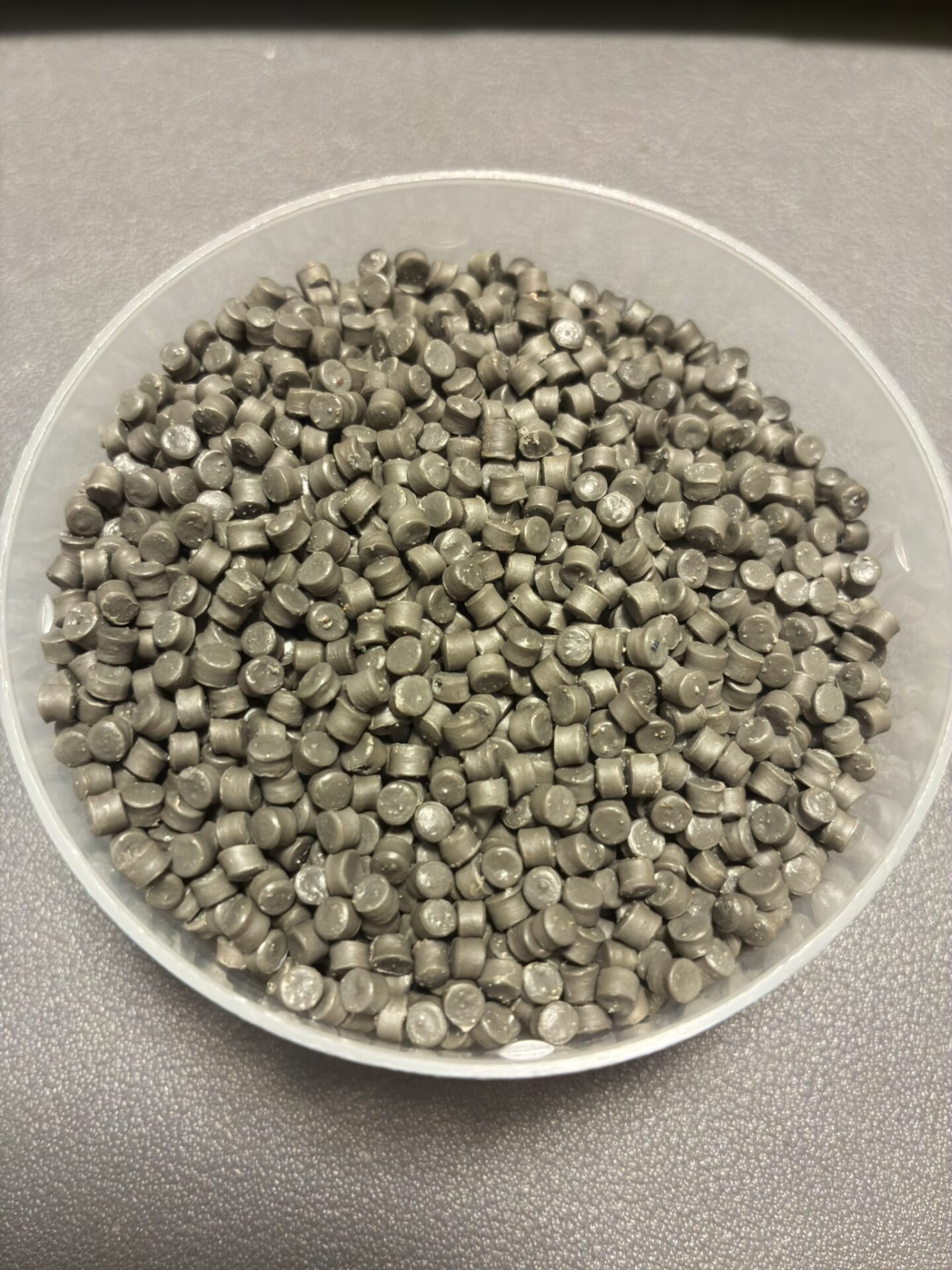
Recycled PP/PE Pellet — Brown, Hot-Cut
Stiffness-oriented · used in Japan for one-way pallet production
Grade #2 is a brown-colored hot-cut PCR (Post-Consumer Recycled) PP/PE pellet, actively used inside Japan for one-way pallet molding. The values shown below represent an average of six samples taken from three FIBC bags (two samples per bag).
With flexural strength of 32.1 MPa and flexural modulus exceeding 1000 MPa, this grade is a strong fit for parts that require stiffness: one-way pallets, thick-wall molded parts, logistics components, pallet-related fittings, and industrial parts.
Supply: FIBC packaging, 2–3 containers per month, ~24 tons per 40ft container.
Grade #3 · Recycled PP — Black, Strand-Cut (ASR-origin)
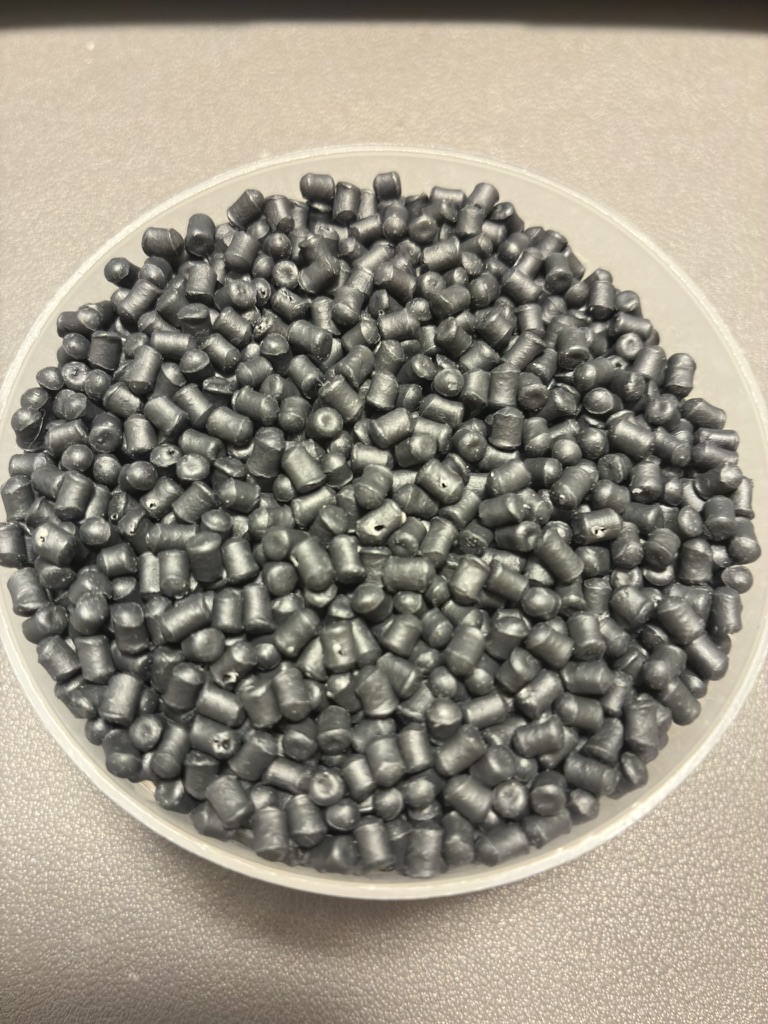
Recycled PP Pellet — Black, Strand-Cut, ASR-origin
High-impact PP · proven in one-way pallet molding · 158-lot statistical data
Grade #3 is a black, strand-cut recycled PP pellet (note: PP only, not PP/PE blend). It has a proven track record in one-way pallet molding, and is also widely used in Japan for industrial materials and civil engineering / construction materials.
A mean Charpy impact value of 14.4 kJ/m² is approximately 3× the Charpy of Grade #1 and 4–5× the Izod of Grades #2 and #4 — making Grade #3 the clear high-impact option in our lineup. Combined with a flexural modulus mean of 1122 MPa, it delivers both stiffness and toughness, which is exactly what one-way and heavy-duty pallets need.
Supply: 1-ton FIBC packaging, 2–3 containers per month, ~24 tons per 40ft container.
Grade #3 — Full Statistical Test Data (158 Lots)
The figures shown in the product card above are means. The full statistical breakdown below (mean, standard deviation, median, max, min) gives buyers a clear picture of both typical performance and the lot-to-lot variation that is normal for any recycled stream. Sampling period: 2026-03-04 → 2026-03-24, sample size n = 158.
| Property (unit) | Mean | SD | Median | Max | Min |
|---|---|---|---|---|---|
| MFR (g/10min) | 14.7 | 1.37 | 14.6 | 18.6 | 10.6 |
| Density (g/cm³) | 0.97 | 0.01 | 0.98 | 1.00 | 0.95 |
| Charpy impact (kJ/m²) | 14.4 | 4.32 | 13.0 | 35.0 | 6.6 |
| Flexural strength (MPa) | 30.7 | 1.41 | 30.6 | 34.3 | 26.8 |
| Flexural modulus 10N–20N (MPa) | 1122 | 102 | 1120 | 1370 | 862 |
| Tensile strength, max (MPa) | 19.8 | 0.75 | 19.8 | 22.2 | 17.9 |
| Tensile strength, break (MPa) | 16.2 | 0.70 | 16.0 | 18.0 | 14.0 |
| Elongation at break (%) | 22.9 | 4.48 | 23.0 | 35.0 | 9.0 |
| Tensile modulus (MPa) | 1141 | 51 | 1140 | 1270 | 993 |
Grade #3 — X-ray Fluorescence Test Data (RoHS-relevant)
For buyers whose end-customers require heavy-metal screening data on incoming resin, Grade #3 ships with X-ray fluorescence (XRF) results for cadmium, lead, chromium, mercury, and bromine, calculated as means across the same 158-lot dataset.
Grade #4 · Recycled PP/PE — Olive-Gray, Strand-Cut

Recycled PP/PE Pellet — Olive-Gray, Strand-Cut
Bulking / blending compound · widely used across Japanese molders
Grade #4 is an olive-gray strand-cut PCR (Post-Consumer Recycled) PP/PE pellet, widely used inside Japan as a bulking and blending compound for pallets and other molded products. Ideal where the buyer wants to dilute virgin resin cost while keeping processability stable.
The standout property is tensile elongation at break of 560.51% — exceptional toughness and ductility that makes this grade well-suited as a flexibility-enhancing blend partner. It can also be used as a main resin where ductile failure is preferred over brittle failure.
Supply: FIBC packaging, 2–3 containers per month, ~24 tons per 40ft container.
Side-by-Side Property Comparison
Use this table to match your application requirements to the right grade. All values are typical reference data, not guaranteed specs. Grade #3 values are mean values from 158 lots (2026/3/4–3/24).
| Property | #1 PP/PE Gray | #2 PP/PE Brown | #3 PP Black (ASR) | #4 PP/PE Olive-Gray |
|---|---|---|---|---|
| Pellet Shape | Hot-Cut | Hot-Cut | Strand-Cut | Strand-Cut |
| Color | Gray | Brown | Black | Olive-Gray |
| Origin material | PCR (post-consumer) | PCR (post-consumer) | ASR (auto shredder residue) | PCR (post-consumer) |
| MFR / MFI (g/10min) | 8.6 | 9.9 | 14.7 (mean) | 4.68 |
| Density | 0.951 | 0.95 | 0.97 (mean) | 0.939 |
| Flexural strength (MPa) | 27 | 32.1 | 30.7 (mean) | 23.74 |
| Flexural modulus (MPa) | 983 | 1066 | 1122 (mean) | 844.51 |
| Tensile strength (MPa) | 22 (break) | — | 19.8 max / 16.2 break (mean) | 17.57 yield |
| Elongation at break (%) | 88.2 | — | 22.9 (mean) | 560.51 |
| Impact (kJ/m²) | 4.8 (Charpy) | 3.1 (Izod) | 14.4 (Charpy, mean) · max 35.0 | 5.04 (Izod) |
| Tensile modulus (MPa) | — | — | 1141 (mean) | — |
| RoHS-relevant XRF data | — | — | Cd 0.1 / Pb 4.5 / Hg 0.0 / Cr 29.1 / Br 34.1 ppm | — |
| Best For | Balanced GP grade | Stiffness-focused | High-impact / heavy duty | Bulking · blending |
| Pallet track record | Proven | Used in Japan | Proven | Used as bulking compound |
Recommended Grade by Application
One-way / export pallets
One-way pallets demand a balance of stiffness, impact, and price. Both #1 and #3 have proven track record; #2 is also actively used in Japan for this exact application.
Heavy-duty / impact-sensitive
For drop-impact tolerance, cold-warehouse use, and heavy industrial loads, you want the highest impact grade. #3 at 14.4 kJ/m² Charpy mean (max 35.0) plus 1122 MPa flexural modulus mean is the clear choice — roughly 3× the impact of #1 and 4–5× #2 / #4.
Stiffness-critical thick-wall parts
If your pallet or industrial part needs to resist sag and creep under sustained load, choose the stiffness leader. #2 with flexural strength 32.1 MPa and modulus 1066 MPa fits well; #3 also offers a similar stiffness profile (modulus 1122 mean) with much higher impact.
Bulking compound / cost reduction
When you want to dilute virgin PP cost while preserving ductility, #4 is purpose-built. Its 560% elongation at break gives toughness even at high loadings in the blend.
Industrial / civil-engineering & construction materials
Grade #3 is already used in Japan for industrial materials and civil engineering & construction materials. ASR-origin PP at this property level is a natural fit for non-electronic, non-food-contact infrastructure parts where toughness and cost matter more than aesthetics.
Buyers who need RoHS-relevant screening data
Grade #3 ships with XRF results for Cd, Pb, Cr, Hg, and Br. Useful for buyers whose customers require an up-front heavy-metal screen before the resin enters their supply chain — even if final RoHS conformity must still be declared based on speciation testing per lot.
Blend Strategy — Use Grade #3 as Your Base Resin
Maximize material yield by blending around Grade #3
Each of the four grades can be molded as a stand-alone resin, and many of our customers do start that way for qualification. But once a buyer is established with us, the most cost-effective and supply-stable approach is to treat Grade #3 as the base resin and blend one of the other three grades into it.
The reason is structural: Grade #3 is our designated export grade, and we can scale up production of it on demand. Grades #1, #2, and #4 are supplied at 1–3 containers per month each, so when you anchor the recipe to #3 and use the others as property modifiers, you protect your monthly throughput against the natural ups and downs of any single recycled stream.
There is also a direct cost benefit: because Grade #3 is already a deep black pellet, blending around it eliminates the need for a separate black-coloring masterbatch. A typical carbon-black masterbatch is dosed at 2–3% by weight on top of the resin cost, and once #3 makes up roughly 20–40% or more of the recipe, the finished pallet comes out black on its own. That is recurring savings on every single ton — no masterbatch SKU to source, no metering pump to maintain, no extra inventory.
Balanced general-purpose pallet recipe
Combine the high-impact ASR-origin #3 with the balanced PP/PE #1. The #1 brings a slightly lower MFR and softer flow profile, which can help fill complex pallet ribs at the same time that #3 carries the impact and stiffness load.
Useful when the buyer wants the toughness of #3 but a more general-purpose flow window. The black of #3 dominates the finished color — no black masterbatch needed.
Maximum-stiffness heavy-duty recipe
Layer the stiffness leader #2 (flexural strength 32.1 MPa, modulus 1066 MPa) onto the high-impact base of #3. The combination pushes flexural performance up further while keeping Charpy impact well above the level of #2 alone (3.1 kJ/m² Izod).
The natural fit for thick-wall pallets, heavy industrial loads, racking-grade pallets, and any part that has to resist sag under sustained weight without becoming brittle.
Ductility-tuned cost-down recipe
Use #4 — with its 560% elongation at break — as a ductility booster on top of the rigid, high-impact #3. This shifts the failure mode of #3 from a more brittle break toward a tougher, more ductile failure, while #4's role as a known bulking compound also pulls down the overall cost.
Recommended where a pallet sees repeated drops, forklift abuse, or cold-warehouse use, and where a small loss of stiffness is acceptable in exchange for break-resistance and price.
① Supply security — because Grade #3 is our export grade, we can ramp up production volume in response to your forecast. Grades #1, #2, and #4 are valuable but volume-limited monthly streams. By making #3 the base of your recipe (typically 60–80%) and using #1, #2, or #4 as the property-tuning addition (typically 20–40%), you get a recipe that scales with your demand and that we can keep delivering month after month — instead of a recipe that breaks the moment one of the smaller streams fluctuates.
② No black masterbatch needed — Grade #3 is already a deep, fully pigmented black pellet from carbon already present in the ASR feedstock. Once it occupies the major share of the recipe, the molded pallet comes out uniformly black with no additional colorant. A typical black masterbatch dosed at 2–3% adds a recurring cost on every ton; eliminating it is a straight saving that flows to the gross margin of every pallet you ship.
Pellet Shape: Hot-Cut vs Strand-Cut
Hot-Cut (Grades #1 and #2)
Hot-cut pellets tend to have a more rounded, lens-like geometry. Bulk density and flow are generally consistent, and the rounded shape can be easier to handle in injection-molding feed systems.
Strand-Cut (Grades #3 and #4)
Strand-cut pellets are made by extruding strands, cooling them in water, and chopping them. The result is a cylindrical pellet shape, which is the traditional and most widely accepted geometry in commodity-resin handling. #3 is the high-impact, ASR-origin option in this shape, and #4 is the bulking-compound option.
Export Terms & Supply Conditions
All four grades are supplied in FIBC packaging (flexible intermediate bulk containers, also called bulk bags or jumbo bags) and shipped on a full container load (FCL) basis, with approximately 24 tons of resin loaded per 40-foot HC container. Grade #3 is supplied specifically in 1-ton FIBC.
| Grade | Packaging | Monthly Supply | Container Load | Domestic Track Record |
|---|---|---|---|---|
| #1 PP/PE Gray Hot-Cut | FIBC | 1–2 containers | ~24t / 40ft | Proven in one-way pallet molding |
| #2 PP/PE Brown Hot-Cut | FIBC | 2–3 containers | ~24t / 40ft | Used in Japan for one-way pallets |
| #3 PP Black Strand-Cut (ASR-origin) | 1t FIBC | 2–3 containers | ~24t / 40ft | Proven in one-way pallet molding · industrial & civil-engineering / construction materials |
| #4 PP/PE Olive-Gray Strand-Cut | FIBC | 2–3 containers | ~24t / 40ft | Widely used as bulking compound for pallets & molded parts |
Incoterms & logistics
We can quote FOB Japan (Tokyo, Yokohama, Kobe, Osaka, depending on origin warehouse) or CFR / CIF to your designated discharge port. Typical destinations include Keelung / Kaohsiung (Taiwan), Busan / Incheon (South Korea), Ho Chi Minh / Haiphong (Vietnam), Laem Chabang (Thailand), and Tanjung Priok (Indonesia).
Documentation
Each shipment includes commercial invoice, packing list, bill of lading, certificate of origin (Japan), and test data sheet per grade. For Grade #3, the test data sheet includes 158-lot statistical data (mean, SD, median, max, min) and the X-ray fluorescence (RoHS-relevant heavy metal & halogen) screening report. Material safety information and recycled-content declarations can be issued on request.
Why Buy Recycled PP / PP/PE from Plastic Pallet Co., Ltd.
We are a Japanese plastic-pallet specialist that has been exporting recycled PP and finished pallets across Asia since 2014. We do not just sell resin — we understand exactly how it behaves on a pallet mold.
Pallet-grade focus, full origin disclosure
Every grade we list has either proven pallet-molding history or is actively used in Japanese molded products. We disclose the origin of each grade — PCR (Post-Consumer Recycled) for #1, #2, #4, and ASR for #3 — so buyers can write defensible recycled-content declarations. We do not sell mystery scrap.
Statistical & XRF test data
Grade #3 ships with 158-lot statistical data and a documented heavy-metal / halogen screening report — the kind of traceability serious export buyers expect.
Asia export track record
Established direct trade flows to Taiwan, Korea, and Vietnam — including ~20,000 plastic pallets per year exported to Taiwan alone.
Direct dialogue with the founder
Inquiries are answered directly by our representative director within 48 hours. No layered sales chain, no translation loss.
Summary
Plastic Pallet Co., Ltd. offers four Japanese-origin recycled polyolefin grades that together cover the full property range needed by Asian plastic-pallet manufacturers and injection molders:
| Grade | Identity | Character | Track Record | Supply |
|---|---|---|---|---|
| #1 | PP/PE · Gray · Hot-Cut · PCR | Balanced general-purpose | Proven in one-way pallet molding | 1–2 containers / month |
| #2 | PP/PE · Brown · Hot-Cut · PCR | Stiffness-focused | Used in Japan for one-way pallets | 2–3 containers / month |
| #3 | PP · Black · Strand-Cut · ASR-origin | High-impact / heavy duty · 158-lot statistical & XRF data | Proven in one-way pallets · industrial & civil-engineering / construction materials | 2–3 containers / month |
| #4 | PP/PE · Olive-Gray · Strand-Cut · PCR | Bulking · blending · ductile | Widely used as bulking compound | 2–3 containers / month |
Whether your target product is one-way export pallets, returnable logistics containers, heavy-duty industrial molded parts, or simply a cost-down blending stream, we can match the right Japanese recycled grade to the application. For most buyers we recommend using Grade #3 as the scalable base resin and blending #1, #2, or #4 as a property-tuning addition, but each grade can also be used stand-alone. Tell us your target product, target volume, and key property targets — we will respond with grade recommendations, blend ratio starting points, test data, and a delivered-port quotation.
Request a Quotation or Sample
We respond directly from Japan within 48 hours, in English or Japanese. Please share your target product, target volume per month, key property requirements (MFR, impact, density), and destination port — we will return grade recommendations, test data sheets, and a delivered-port quotation.