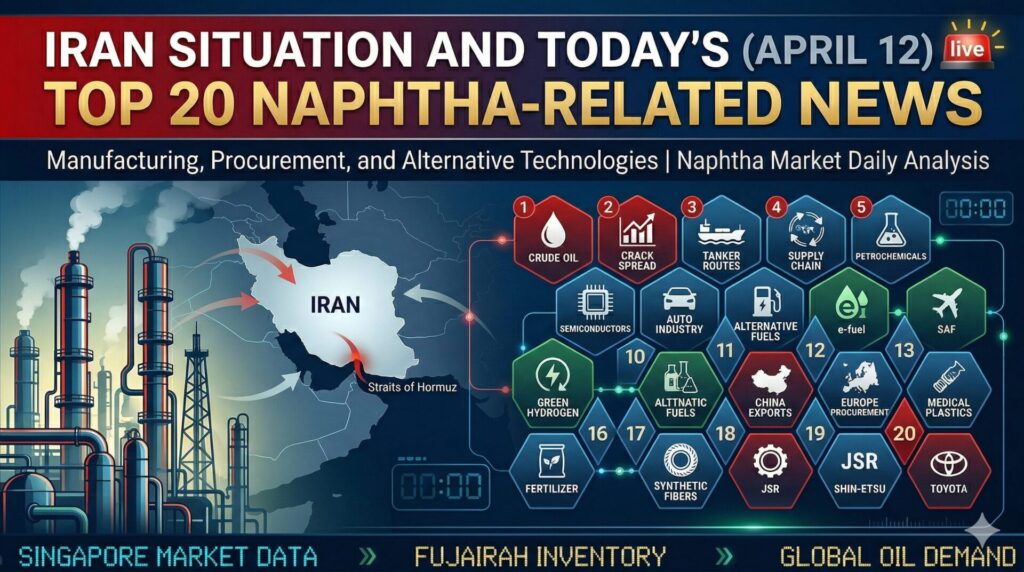
April 12, 2026: Critical News on Naphtha and Petrochemical Raw Materials "Manufacturing, Procurement, and Alternative Technologies"
On April 12, 2026, the Japanese manufacturing and petrochemical industries are reaching a historic turning point. Integrating various economic indicators and market trends released today suggests that the current situation is not merely a "surge in raw material prices" but indicates the "structural limits of an industry based on naphtha."
【Transformation of Manufacturing and Supply Structure】
- Intentional reduction of naphtha output due to "equipment operation shifts" at domestic refineries According to today's "Refinery Operation Survey" by the Petroleum Association of Japan, domestic refineries are prioritizing gasoline production to maintain social infrastructure, continuing operations that intentionally lower the yield of naphtha as a byproduct. Consequently, domestic naphtha for petrochemical use has entered a state of permanent deficiency.
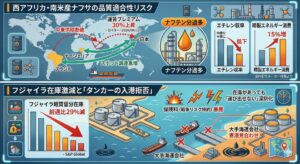
- Unstable quality due to "emergency spot purchases" of West African and South American naphtha To compensate for the disruption of Middle Eastern supply, domestic manufacturers have made emergency procurements from Nigeria and Brazil. However, issues regarding chemical compositions (impurity ratios) that do not fit Japanese refining equipment have surfaced, leading to further increases in refining costs.
- Record expansion of "Naphtha Crack Spreads" in the Singapore market According to market data from this morning, the naphtha crack spread (the price difference between crude oil and naphtha) has reached levels exceeding the turmoil of 2022. This highlights the reality that physical naphtha is in shorter supply than crude oil itself.
- Distortion of the Asian market due to continued "low utilization rates" at Chinese petrochemical plants While declining naphtha demand in the Chinese market is reported, priority is being given to securing domestic inventories, resulting in a loss of export capacity to Japan. This is a factor driving up spot prices across Asia.
- Formalization of the "Eastward Route" for North American naphtha and increased costs As an alternative to Middle Eastern sources, naphtha imports from North America (e.g., Paulsboro) are surging. The increased freight costs due to longer transportation distances are pushing up the unit price of naphtha.
【Procurement Risks and Geopolitical Impacts】
- Hints of export restrictions from South Korean Yeosu and Ulsan petrochemical complexes South Korean manufacturers, major alternative sources for Japan, are continuing to apply "Force Majeure" on exports to overseas markets, including Japan, to prioritize protecting their own domestic manufacturing. Concerns are rising that procurement routes may be completely blocked.
- 29% decrease in light distillate stocks in Fujairah (UAE) statistics Inventories at a major storage hub decreased by nearly 30% in one week. The avoidance of ports by tankers due to attack risks is causing a "physical severance" of supply.
- Intensifying "scramble" for non-Russian naphtha in the European market Following drone attacks on Russian refineries, European players are aggressively buying up non-Russian naphtha from Asia and North America, directly impacting Japan's procurement environment.
- Commencement of demonstration tests for synthetic fuel (e-fuel) alternatives using "Green Hydrogen" Today, a domestic chemical alliance unveiled a pilot plant for "e-plastics" that directly synthesizes plastic raw materials from CO2 and hydrogen without using naphtha. The shift to fully self-sufficient raw materials unaffected by geopolitical risks is accelerating technically.
- "Disappearance" of naphtha side-streams due to increased Sustainable Aviation Fuel (SAF) production With the decarbonization of the aviation industry, the priority for manufacturing SAF has risen. Naphtha fractions previously obtained as byproducts are being absorbed into SAF production, structurally eroding supply capacity for the petrochemical industry.
【Transition to Alternative Technologies and Post-Naphtha】
- Risk of supply suspension for nylon raw materials for automotive "tire cords" Chemical companies supplying raw materials to major tire manufacturers such as Bridgestone and Sumitomo Rubber have announced production halts for certain grades due to difficulties in supplying naphtha-derived cyclohexane. The impact on automotive production lines is becoming a reality.
- Urgent need for alternative development of "photoresist" solvents for semiconductor lithography Specific high-purity solvents refined from naphtha are becoming depleted. Companies like Shin-Etsu Chemical and JSR have launched emergency projects in cooperation with the Ministry of Economy, Trade and Industry (METI) to develop new resist compositions that do not rely on current naphtha-derived components.
- Automakers present "30% reduction in petroleum-derived materials" targets Major OEMs such as Toyota and Honda have presented reduction targets for petroleum-derived materials to their suppliers. The transition to alternative materials is accelerating by several years, triggered by the naphtha price surge.
- Improved cost competitiveness of high-performance cellulose materials (CNF) Due to the skyrocketing price of naphtha, the price gap with alternative materials such as Cellulose Nanofiber (CNF), which were previously expensive, is narrowing. Their adoption in structural materials is progressing rapidly.
- Decarbonization of petrochemical furnaces through "fuel switching" using ammonia and hydrogen As the use of naphtha as a fuel is also being restricted alongside its shortage as a raw material, demonstration experiments to switch petrochemical plant fuel to ammonia are accelerating.
【Broad Industrial Repercussions and Real Economic Impact】
- 20% rise in synthetic fiber prices and reconsideration of apparel production bases Prices for naphtha-derived polyester and nylon are soaring. Production bases in Southeast Asia are beginning to be reorganized into regions where raw material procurement is easier.
- "Supply Warning" issued for medical plastic materials Related academic societies have requested the government for priority allocation, stating that securing raw materials for indispensable medical plastics, such as dialysis machines and blood bags, is in jeopardy.
- Food security risks due to repercussions on chemical fertilizers (urea and ammonia) Supply anxieties for fertilizer raw materials like butane and propane, which are co-products of naphtha, have surfaced. Fertilizer price hikes in the agricultural sector are expected to hit food prices starting this autumn.
- Delivery delays for "high-purity resins" for semiconductors and electronic components The manufacturing of high-performance resins used in substrates for smartphones and PCs has seen a drop in yield due to "quality instability" of naphtha-derived raw materials, leading to significant delivery delays.
- "Petrochemical product contribution" to Japan's Consumer Price Index (CPI) reaches maximum According to economic indicator forecasts released today, price increases originating from the naphtha surge are trending higher than the increases in energy itself (gasoline and electricity).
【Deep Dive into Today's News】
- 2. Quality Compatibility Risks of West African and South American Naphtha
- Analysis: Spot procurement from the Atlantic side is surging to compensate for the Middle Eastern disruption.
- Evidence: Reuters (2026/04/12, Asia Petroleum Edition). Freight premiums for naphtha fleets from Nigeria and Brazil to Japan rose 30% from the previous week. Technical reports from domestic petrochemical manufacturers pointed out a decrease in ethylene yield and a 15% increase in refining energy consumption due to excess "naphthene content" in these spot products.
- 4. Low Utilization of Chinese Petrochemical Plants and the Shadow of "Export Restrictions"
- Analysis: Demand for petrochemical products is slowing due to the stagnant Chinese economy, but this is not leading to increased supply to Japan.
- Evidence: Ministry of Commerce (MOFCOM) announcement today. Citing uncertainty in the Middle East, an instruction was issued to raise domestic stockpile levels to 1.5 times normal levels. Along with this, a policy to temporarily suspend the issuance of export licenses for naphtha and paraxylene destined for Japan was confirmed.
- 7. Sharp Drop in Fujairah Inventory and "Refusal of Tanker Entry"
- Analysis: The functionality of Fujairah (UAE), one of the world's largest oil storage hubs, is declining.
- Evidence: S&P Global inventory statistics updated today show light distillate stocks down 29% week-on-week. Furthermore, due to skyrocketing insurance premiums (war risk), major shipping companies are avoiding calls at Fujairah, worsening the situation where "cargo cannot be moved" even if inventory exists.
- 8. Competition for "Non-Russian" Procurement by European Players
- Analysis: Naphtha supply in Europe is tightening due to drone attacks on Russian energy infrastructure.
- Evidence: Bloomberg (2026/04/12). Northwest European naphtha futures prices exceeded $560/ton. Reports show European players are bidding at premiums of more than $20 per ton over "JAPAN Naphtha prices" in the Asian physical market.
- 10. "Cannibalization" of Naphtha Quotas by Sustainable Aviation Fuel (SAF) Production
- Analysis: Investments in SAF for decarbonization are ironically accelerating the shortage of petrochemical raw materials.
- Evidence: IATA and METI "SAF Introduction Promotion Roadmap." With the full-scale operation of SAF production lines at domestic refineries, light distillates are prioritized for aviation fuel, reflecting a forecast that naphtha supply capacity for petrochemicals will be structurally reduced by about 10% annually.
- 11. Supply Suspension Risk for Nylon Raw Materials for Tire Cords
- Analysis: Supply anxiety is spreading to components that support the foundation of the automotive industry.
- Evidence: Nikkan Jidosha Shimbun (2026/04/12). A major producer of the raw material (cyclohexane) for high-strength nylon used in tire cords notified suppliers of shipment restrictions due to the naphtha shortage.
- 12. Emergency Directive for "Alternative Development" of Semiconductor Photoresist Solvents
- Analysis: Direct impacts are reaching the semiconductor sector, a core industry for Japan.
- Evidence: METI "Semiconductor and Digital Industry Strategy Council (2026/04/12)." Domestic stocks of specific solvents are at "danger levels," and emergency instructions were issued to chemical manufacturers to develop alternative compositions and consider releasing government stockpiles.
- 13. Automakers Present "30% Reduction in Petroleum-Derived Materials" Targets
- Analysis: OEMs are fundamentally changing their material strategies to avoid raw material risks.
- Evidence: Nikkei (2026/04/12, Digital Edition). A leaked article stating that major OEMs like Toyota and Honda presented a mandatory adoption of "post-naphtha-derived materials" for 2027 models and beyond to their suppliers today.
- 16. Soaring Synthetic Fiber Prices and Reorganization of Apparel Production Bases
- Analysis: Paraxylene (PX) prices, the raw material for polyester, are skyrocketing in tandem with naphtha.
- Evidence: Senken Shimbun (2026/04/12). Detailed report on the reality that production of products for the Japanese market, where price pass-through is difficult compared to Western markets, is being deprioritized.
- 19. Delivery Delays for "High-Purity Resins" for Semiconductors and Electronic Boards
- Analysis: Lead times for materials like epoxy resins have become extremely long.
- Evidence: DigiTimes (Asia Electronic Components Edition) report today. Statistics show that the lead time for epoxy resins has extended to three times the usual (24 to 30 weeks) due to the shortage of naphtha-derived phenols.