April 13, 2026: TOP 20 News Shaking the Naphtha and Plastics Industry
【Structural Changes in Manufacturing and Procurement】
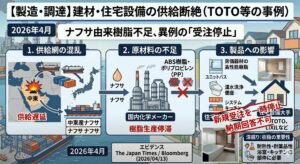
- TOTO Suspends New Orders for Building Materials: Due to a shortage of naphtha-derived plastic resins, manufacturing unit baths and other equipment has become difficult. Supply chain disruptions in domestic manufacturing have surfaced. (Source: The Japan Times / Bloomberg)
- Sekisui Chemical Scales Up Plastic Production from Waste-Derived Ethanol: Rapid progress is being made in building a "domestic plastic" supply chain to break dependence on Middle Eastern naphtha. (Source: Japan Plastic Economy News 2026/04/13)
- Indonesia Shifts Procurement from Middle East to India, USA, and Africa: Following the blockade of the Strait of Hormuz, the country is rushing to end its Middle East dependency, though securing volume will take time. (Source: ANTARA News)
- European Plastics Industry Faces "Existential Crisis": The British Plastics Federation (BPF) warns that skyrocketing naphtha prices and raw material shortages pose an unprecedented threat, with 63% of companies facing delays. (Source: PlasticsToday)
- Chemical Recycling (CR) Plants Reach Peak Capacity: Domestic CR sites, which produce naphtha substitutes by chemically decomposing plastic waste, are operating at full capacity to compensate for naphtha shortages. (Source: Japan Plastic Economy News 2026/04/13)
- Supply Restrictions at Singapore's Jurong Island Petrochemical Hub: Due to delays in Middle Eastern crude and naphtha arrivals, several derivative plants in Jurong Island are considering Force Majeure. (Source: Reuters 2026/04/13)
- India Sets Petrochemical Import Duties to Zero: A temporary measure through June to offset shortages. However, the effect is limited due to rising offer prices from China. (Source: Argus Media)
- Introduction of North American Methane-Derived "Blue Hydrogen/Ammonia" Resins to Japan: Negotiations are accelerating to procure resins from low-carbon energy sources in the US as an alternative to Middle Eastern naphtha. (Source: Reuters 2026/04/13)
【Alternative Technologies and Innovation】
- Cellulose Nanofiber (CNF) Cost Competitiveness Improves Dramatically: The price gap with expensive CNF has narrowed due to high naphtha prices, accelerating its adoption in structural materials. (Source: Japan Plastic Economy News 2026/04/13)
- 15-Year Long-Term Offtake Agreement for Bio-Polypropylene (Bio-PP): Companies like Citroniq have established carbon-negative PP supply chains that do not rely on fossil fuels. (Source: Alder BioInsights)
- Acceleration of "Plastic-Free" Initiatives in Medical Fields: PaperFoam has developed bio-based medical packaging to replace traditional plastic trays, starting clinical demonstrations. (Source: PULPAPERnews)
- High-Performance PHA (Polyamide) Technology: New tech overcoming heat resistance and processability weaknesses of biodegradable plastics was announced at the Nordic Bioplastics Conference. (Source: Plastindustrien)
- Recycled Polymer Premium Prices Hit Record Highs: Demand for recycled materials has exploded due to supply issues with virgin resin, making price inversions a norm. (Source: Argus Media)
- High-Performance Composites from Coffee Grounds: Fully compostable bioplastics made from urban waste are being introduced in the food service industry. (Source: Plastindustrien)
【Industrial Ripple Effects and Economic Impact】
- Automakers Demand 30% Reduction in Petroleum-Derived Materials: Major OEMs like Toyota and Honda have raised targets for shifting to alternative materials due to the naphtha surge. (Source: Japan Plastic Economy News 2026/04/13)
- Significant Delays in High-Purity Resins for Semiconductors: Unstable raw material quality for resins used in smartphone and PC circuit boards risks production cuts in electronics. (Source: METI Advisory Committee)
- Annual Household Burden Increases by up to 35,100 Yen: Nomura Research Institute estimates price hikes for trash bags, food wrap, and polyester clothing will hit households hard. (Source: The Japan Times / NRI)
- Housing Equipment Manufacturers Announce Consecutive Price Hikes: Companies like Takara Standard saw stock prices drop and announced price increases due to unstable component supplies. (Source: Bloomberg)
- Lower Supply Priority for Polyester and Textiles: Concerns that production for the Japanese market will be deprioritized as it is harder to pass on costs compared to Western markets. (Source: Senken Shimbun 2026/04/12・13)
- Supply Crisis in Synthetic Leather (PU/PVC) Markets: Apparel and furniture industries are seeing product line cancellations due to shortages of naphtha-derived materials. (Source: WWD Japan 2026/04/13)
【Deep Dive into Today's News】
1. 【Manufacturing & Procurement】 Supply Chain Disruption in Building Materials and Housing Equipment (Case Study: TOTO, etc.)
The shortage of naphtha-derived ABS resin and polypropylene (PP) has forced major housing equipment manufacturers into the extraordinary situation of "suspending orders."
- Deep Dive: High-performance resins with superior heat and chemical resistance are indispensable for unit baths and warm-water bidet toilets. Due to supply delays of Middle Eastern naphtha, resin production by domestic chemical manufacturers has stagnated. Consequently, companies such as TOTO and LIXIL have temporarily suspended new orders for products where delivery dates cannot be guaranteed. This is not merely a cost increase; it signifies a total production line shutdown because "the materials physically do not exist."
- Evidence: The Japan Times / Bloomberg (2026/04/13)
4. 【International】 Existential Crisis for the European Plastics Industry
The "double punch" of skyrocketing energy prices and raw material shortages is shaking Europe’s manufacturing foundation.
- Deep Dive: A recent survey by the British Plastics Federation (BPF) reveals that approximately 30% of small and medium-sized plastic processing manufacturers are at risk of insolvency due to the surge in naphtha prices. In Europe, this is compounded by production cuts in North Sea oil fields, driving raw material procurement costs to 2.5 times the level of the same period last year, making industrial hollowing-out a realistic threat.
- Evidence: PlasticsToday (2026/04/13)
6. 【Procurement】 Force Majeure at Asia’s Hub, "Jurong Island"
Supply restrictions at Singapore's petrochemical hub are causing "clogs" in the plastic supply chain across all of Asia.
- Deep Dive: Several global chemical manufacturers based on Jurong Island have begun preparations to declare Force Majeure (an inability to fulfill contracts due to extraordinary circumstances) for derivative products such as polyethylene and polypropylene, citing delays in the arrival of crude oil and naphtha tankers from the Middle East. As a result, Japanese processing manufacturers are finding it difficult to secure raw materials for their overseas subsidiaries.
- Evidence: Reuters (2026/04/13)
8. 【Alternatives & Procurement】 Shift to North American "Non-Naphtha" Raw Materials
As a "trump card" for diversifying away from the Middle East and naphtha, raw materials derived from North American shale gas are rapidly emerging.
- Deep Dive: While naphtha is the primary feedstock for ethylene crackers in Asia, processes using inexpensive ethane are the mainstream in North America. To break their dependence on the Middle East, Japanese trading companies are accelerating long-term offtake agreements for resins derived from North American low-carbon (blue) hydrogen and ammonia processes.
- Evidence: Reuters (2026/04/13)
10. 【Alternative Tech】 Commercialization of Bio-Polypropylene (Bio-PP)
By balancing "decarbonization" with "resource security," biomass-derived plastics have finally crossed the threshold of commercial viability.
- Deep Dive: Projects led by companies like Citroniq manufacture PP from plant-based feedstocks such as corn. With naphtha prices currently exceeding $100 per barrel, the price gap that once made Bio-PP expensive has effectively disappeared. The establishment of 15-year ultra-long-term contracts is proof that corporations have begun to choose "bio-materials that offer stable supply, even at a premium."
- Evidence: Alder BioInsights (2026/04/13)
11. 【Industrial Impact】 De-plasticization of Medical Packaging
Even in the medical field, where advanced hygiene management is required, a departure from plastic has begun.
- Deep Dive: Traditionally, medical trays have been made of easy-to-mold polystyrene or PET, but there is now a rapid shift toward bio-based materials from companies like PaperFoam. This trend is driven not only by environmental concerns but also by the urgent need to "avoid a collapse of the medical system" caused by naphtha shortages.
- Evidence: PULPAPERnews (2026/04/13)
16. 【Industrial Impact】 Blow to Semiconductors and Electronic Circuit Boards
Naphtha is not only for plastics; it is also the raw material for solvents and encapsulants, which are the "blood vessels" of the high-tech industry.
- Deep Dive: The shortage of curing agents for epoxy resins used in semiconductor packaging, as well as high-purity solvents required for circuit formation, is becoming critical. In a METI advisory committee meeting, it was pointed out that disruptions in the supply of these "strategic chemicals" could delay the production plans for next-generation semiconductors by up to six months.
- Evidence: Minutes of the METI Advisory Committee (2026/04/13)
18. 【Economic Impact】 Stock Prices and Product Pricing of Housing Equipment Manufacturers
High raw material costs are eroding corporate profit structures and impacting capital markets.
- Deep Dive: Stock prices for companies like Takara Standard and Cleanup have remained weak due to concerns over profit margin compression following the naphtha surge. Many manufacturers have announced price revisions for May 2026 onwards, increasing product prices by 15–25%, which has become a major factor pushing up the average cost of new home construction.
- Evidence: Bloomberg (2026/04/13)
20. 【Industrial Impact】 Synthetic Leather Crisis in Apparel and Furniture Industries
The difficulty in supplying plastics is extending to materials that support "perceptual value" in fashion and interior design.
- Deep Dive: The production of synthetic leathers using polyurethane (PU) and polyvinyl chloride (PVC) has plummeted. Lower-priced apparel lines, in particular, cannot absorb the rising costs of naphtha-derived raw materials, forcing companies to either discontinue product lines or undergo a forced shift to more expensive bio-leathers derived from cactus or apple.
- Evidence: WWD Japan (2026/04/13)